Songs › The Beatles › I Am the Walrus
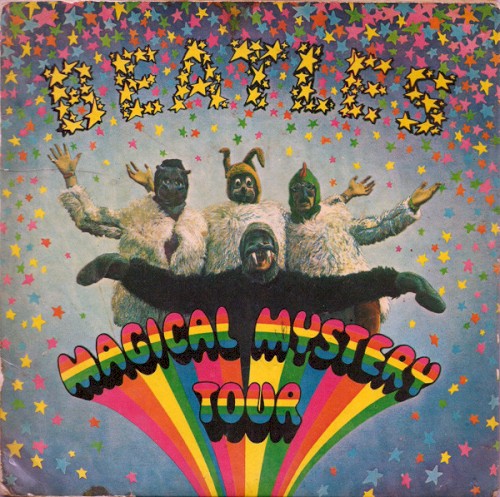
The Beatles
I Am the Walrus
Every note was scored except the radio, which was live.
Hollow marks: the other 49 scored songs · Hatched band: the Crossover Zone
The case
The strongest honest argument for each side, then the ruling.
The Garcia argument
During the mix a radio was tuned across the dial and a live BBC broadcast of King Lear was fed straight onto the tape. Lennon did not know what the play was. Whatever lines happened to be spoken in those minutes are part of the song for good. It is chance, used once.
The Lennon argument
Everything else was specified. A 16-piece ensemble played George Martin's score, sixteen singers sang written whoops and chants, and the master was made by splicing two of seventeen mixes. The radio could only be added because the piece is a tape. It could not have been performed.
The verdict: GLI 90
A constructed object with a window left open during the mix. The window makes it one of the best stories on the Index, and it costs only a few points, because the chance element was captured once and fixed like everything else.
What is fixed
- Orchestral and choral scores
- The splice
- The radio extract as captured
What is open
- What the radio was playing that evening
Evidence dimensions
Each runs from 0, Garcia, to 100, Lennon. Their weighted composite is 90. The published GLI is 90, the same.
Fixed, with a splice in the middle.
Inferred. Nothing here could be varied without loss.
Scored orchestra and choir, with one element left to whatever was on the radio.
Layered construction over a basic track.
The master is two mixes joined, with a live broadcast baked in.
Transformational tolerance
Very low. Even the Beatles could not have made the same mix twice.
Confidence: 86%
Sessions, scores and the mix are documented day by day.
Keep arguing
Every placement is relative. These are the songs this one was measured against.
Cross-band twin
Closest song from the other band
 Attics of My LifeGLI 88The most Lennon song the Dead played, and a choir could sing it.Compare the two
Editorial counterpart
Chosen because it argues back
 A Day in the LifeGLI 87
Both leave one planned gap for chance. One gave it to forty musicians. The other gave it to a radio.
Compare the twoThe record
- A 16-piece ensemble recorded George Martin's score, and sixteen session singers sang written parts.Source ↗
- During mixing on 29 September 1967 a live BBC radio broadcast of King Lear was fed straight into the mix. Lennon did not know what the play was.Source ↗
- Two of seventeen mono mixes were spliced to make the master.Source ↗
- Sixteen takes of the basic track were recorded, five of them complete.Source ↗
Where the sources disagree
- No source that was opened states whether the Beatles ever played it live.
Catalog facts
- Catalog no.
- GLI·TB·014
- Artist
- The Beatles
- Writers
- Lennon–McCartney
- Release
- First released as the B-side of Hello, Goodbye, November 1967, and on Magical Mystery Tour.
- Released
- 24 November 1967
- Duration
- 4:33
Sources
- Wikipedia: I Am the Walrus
- Beatles Bible: I Am the Walrus, in the studio
- Beatles Bible: 29 September 1967 session
Classified 5 October 2026