Songs › Grateful Dead › St. Stephen
Grateful Dead
St. Stephen
Three writers, several sections, and a bridge that came and went.
Hollow marks: the other 49 scored songs · Hatched band: the Crossover Zone
The case
The strongest honest argument for each side, then the ruling.
The Garcia argument
Live versions usually carried a section that is not on the studio recording at all. The band retired the song in 1971, brought it back in 1976 with a looser feel, and at Cornell split it in two around a 16-minute Not Fade Away. The version people treat as definitive is a concert recording.
The Lennon argument
It is one of the most composed things the early Dead wrote. Hunter wrote the words, Garcia the main music and Lesh a separate coda, and the sections follow in a fixed order with a signature riff. The album it comes from was recorded twice and then remixed.
The verdict: GLI 58
A sectional written song whose parts were rearranged over the years. The material is predetermined; which parts appear, and at what tempo, was decided era by era. It sits on the Lennon side of centre, short of Sugar Magnolia.
What is fixed
- The riff
- Verses and lyric
- The order of the main sections
What is open
- Whether the bridge is played
- Tempo and feel
- What it is joined to
Evidence dimensions
Each runs from 0, Garcia, to 100, Lennon. Their weighted composite is 58. The published GLI is 58, the same.
Several composed sections in a set order, with one that was added and later removed.
A 1969 version and a 1977 version differ in tempo, feel and which sections appear.
Verses, riff and coda were written by three people. The links between songs were not.
Mostly composed, with an instrumental passage in the middle.
The studio take is not treated as the reference. The Live/Dead version is.
Transformational tolerance
It lost and regained a whole section and changed tempo between eras.
Confidence: 84%
Counts disagree widely between sources (289 and 193). The arrangement history is well described.
Keep arguing
Every placement is relative. These are the songs this one was measured against.
Cross-band twin
Closest song from the other band
 Revolution 1GLI 57The take ran ten minutes. The last six became a different track.Compare the two
Editorial counterpart
Chosen because it argues back
Revolution 1GLI 57Each exists in more than one arrangement, and each lost a section that turned into something else.
Compare the twoThe record
- Hunter wrote the words, Garcia most of the music, and Lesh composed the coda that carries it into The Eleven on Live/Dead.Source ↗
- Live versions usually included a section, absent from the studio recording, known as the William Tell bridge.Source ↗
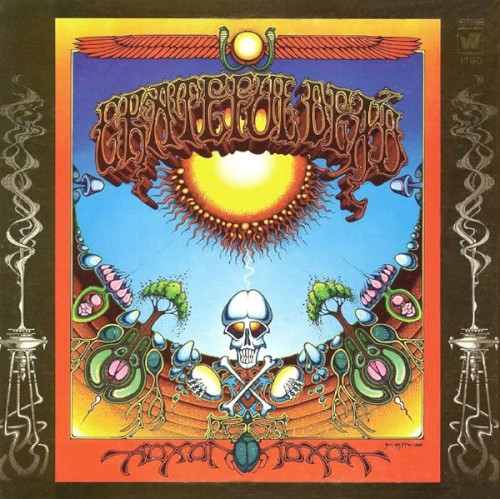
- Aoxomoxoa was recorded on 8-track, scrapped, and re-recorded on 16-track; Garcia and Lesh remixed it again in 1971.Source ↗
- It left the repertoire in 1971, returned from 1976 to 1979, and came back for a few performances in 1983.Source ↗
- At Cornell on 8 May 1977 it was split around a 16-minute Not Fade Away.Source ↗
Where the sources disagree
- Performance count: 289 (dead.net) or 193 (setlist.fm). The gap is unexplained.
Catalog facts
- Catalog no.
- GLI·GD·010
- Artist
- Grateful Dead
- Writers
- Jerry Garcia / Phil Lesh / Robert Hunter
- Release
- Aoxomoxoa (1969)
- Released
- 20 June 1969
- Duration
- 4:26
- Performed
- 289 times (dead.net ("289 known performances")); 193 per setlist.fm
- First played
- 24 May 1968
- Last played
- 31 October 1983
Sources
- Wikipedia: St. Stephen (song)
- Wikipedia: Aoxomoxoa
- dead.net: Greatest Stories Ever Told, Saint Stephen
- Wikipedia: Live/Dead
Classified 5 October 2026